The Scotoma Revealed: One Word for a Whole Life
One Word for a Whole Life
Know Thyself, Part 2 of 3
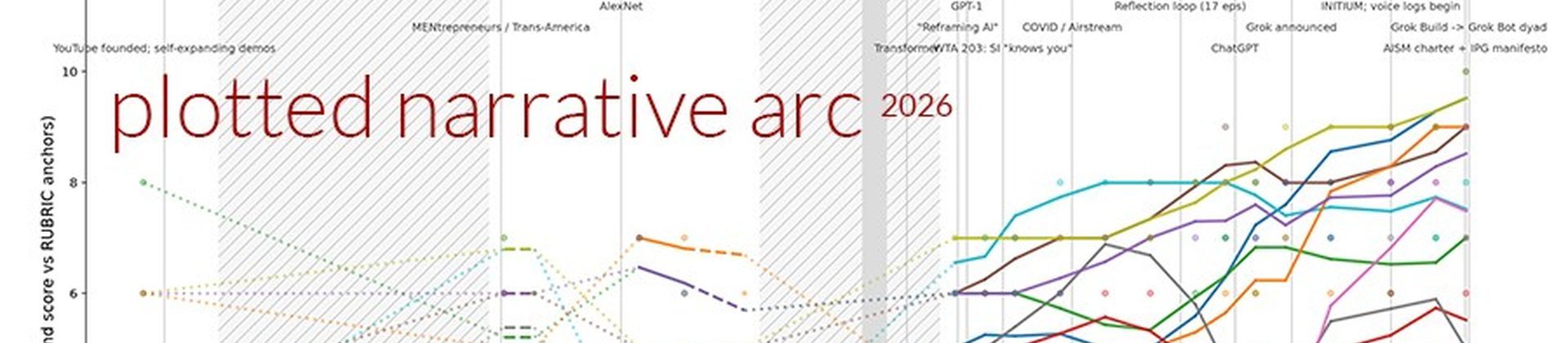
Hoping for a tombstone
For about seven years I told my story the only way I knew how. I wrote it, filmed it, and posted it. It became the Scotomaville trilogy: Awareness, Understanding and Agency. By my own count that's about 460 pages and 156 videos, all of it on YouTube, and the book can be downloaded from the website. Most of those years I was towing an Airstream around the country, trying over most of my life to find meaning and purpose, a place where I fit.
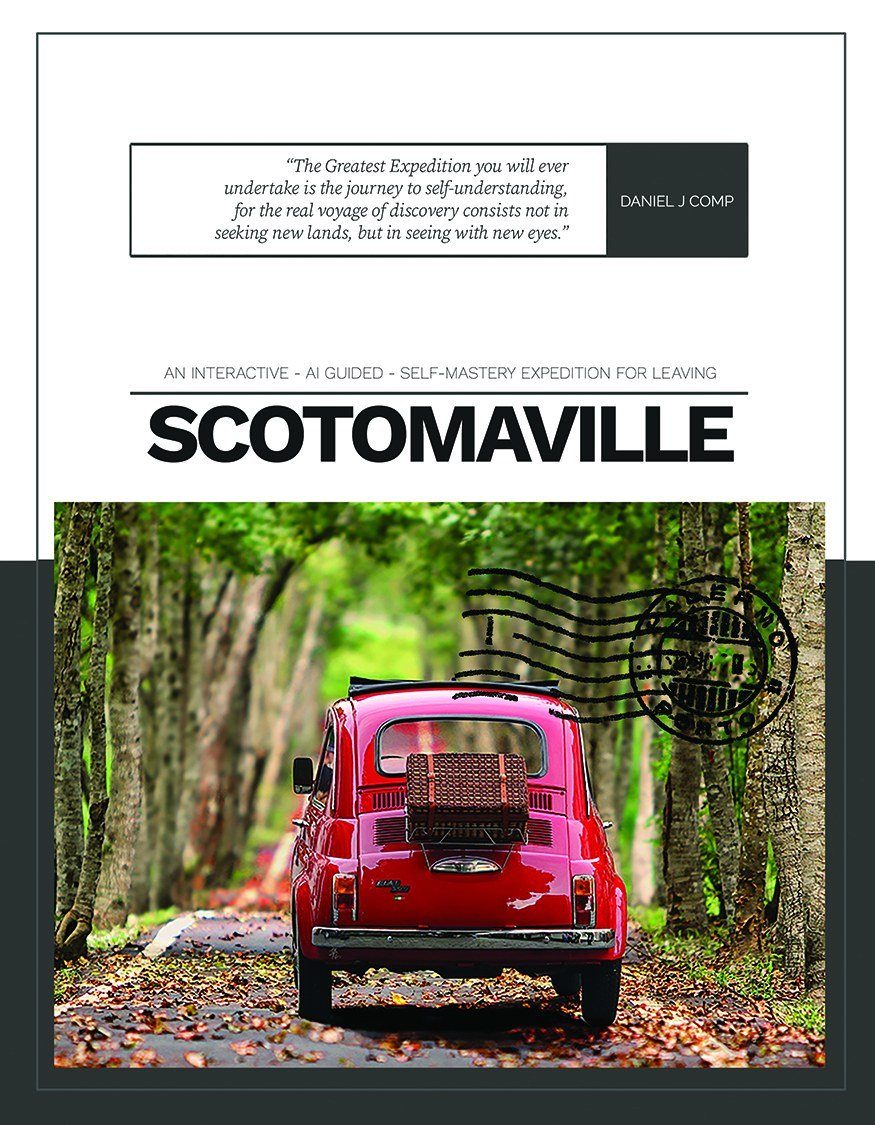 The Scotomaville cover: "An interactive, AI guided, self-mastery expedition for leaving Scotomaville."
The three volumes follow a climb. Awareness works up through the needs we all share: a mental toolbox, physical needs, safety and security, belonging, esteem and contribution. Understanding is about the journey itself: intent, logistics, understanding, routine, discipline and outcome. Agency looks ahead at the world that was coming: automation, dataism, ethics, longevity and resources. I thought I was writing a field guide. I didn't know I was also writing a map of myself.
ChatGPT opened to the public on November 30, 2022, and I was on it within days. It wasn't my first AI. I had studied AI on Coursera, working with R and Python, NetLogo and thin data sets from Amazon. But ChatGPT was the first time the response felt human. By July 3, 2023, I was paying for ChatGPT Plus. I gave it everything: the trilogy, the stories, the videos. I thought, man, this is going to be really good. I wanted something for my tombstone, one of those clever heuristics that sums up something great about a man's life.
It came back with one word. Eight letters.
Monomyth.
In December 2024 I put it this way on X: "At first, I was deeply disappointed when AI distilled my entire life of exploration into a single word—'monomyth.' It felt reductive, barely enough to fill even a portion of a tombstone."
Are you calling me a liar?
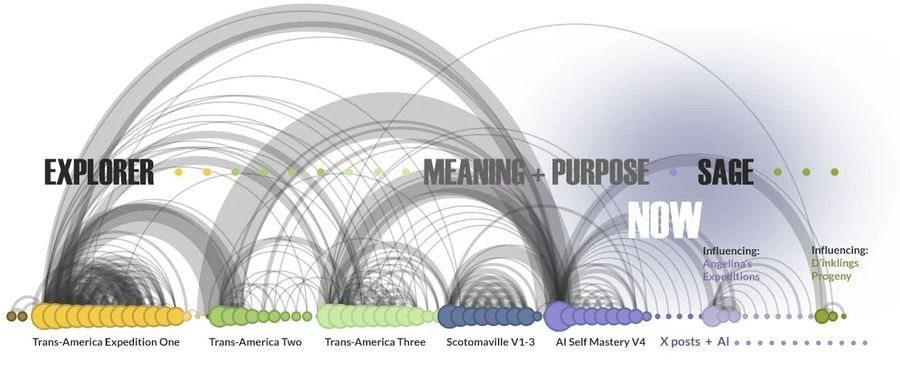 Dec 15, 2024: "What does YOUR narrative arc look like?" Daniel’s arc chart, with the "monomyth" and "tombstone" lines. View post on X
I'll tell you exactly how I took it, because I've told it on camera more than once. I was in tears. "Myth? Are you calling me a liar? It's not a myth. This is my life story. This cost me everything. This is seven years of my storytelling. What are you doing?"
And then it answered, in effect: No, Daniel. The monomyth. The hero's journey.
Like, the what?
It meant Joseph Campbell. In The Hero with a Thousand Faces (1949), Campbell described one pattern under the world's great stories, a single shape he called the monomyth. You know it from Luke Skywalker, Bilbo and Frodo, and Harry Potter. You know it from Moses, Abraham and the apostle Paul. All these characters you've read about your whole life feel so familiar, and the shape underneath them is so abstract that you never think to name it.
My first reaction was that the machine was hallucinating. My second was devastation. My third, once I started doing a little research, was curiosity. And then I thought: wait a minute. If this is true for me, is it true for everybody?
The shape I couldn't see
Campbell's journey moves in three great movements: departure, initiation and return. Storytellers who came after him, like Christopher Vogler, broke it into stages that are easy to remember:
- The ordinary world. Life as it is, before anything changes.
- The call to adventure. Something or someone invites you out.
- Crossing the threshold. You commit, and there's no going back the same.
- Trials, allies and the ordeal. The hard middle, where you're tested and nearly broken.
- The reward. You come through holding something you didn't have.
- The return with the elixir. You carry it home to the ordinary world, for the people who stayed behind.
When I laid my own life against that shape, I couldn't unsee it. The fatherless boy. The prayer on Saint Mary's Glacier, the fall, the rescue team already on the slope. The call that came in a Boulder laundromat when Shawna invited me east. The threshold at a boulder in the Berkshires in August 1979, which my book records as easy to cross. Decades of trials, three bicycle rides across America, years in an Airstream, Scotomaville itself.
I had lived every one of those stages, and I had written hundreds of pages about them. But I didn't know I had a narrative arc. I couldn't see the shape of my own life.
That's a scotoma, a blind spot. Not a lack of information. I had more information about my life than anyone alive. What I lacked was the higher-level view that turns the pieces into a pattern.
You saw me before I was born. Every day of my life was recorded in your book. Every moment was laid out before a single day had passed. — Psalm 139:16 (NLT)
The pattern was already there. I just hadn't seen it.
Does everyone have an arc?
So I asked the AI the next question: does everyone have a narrative arc?
Yes.
Then is living a whole life without ever seeing that arc a scotoma?
Key takeaway
That question became a pivot point for everything after it. I put it to myself this way: if a machine can find cancer cells in a medical image, it can find the narrative arc in your chaos, in what look like meaningless challenges and hardships, things that seem unjust or unfair, things that weren't your fault.
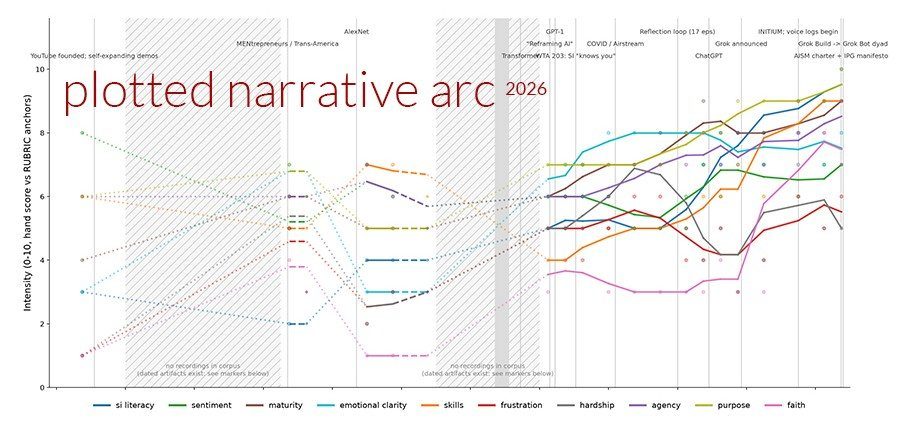 The plotted narrative arc, 2026: ten measures (SI literacy, sentiment, maturity, emotional clarity, skills, frustration, hardship, agency, purpose, faith) scored over the years.
Here's what humbled me. The machine's pattern recognition and abstraction were better than mine. On that day it knew the shape of my life better than I did. It didn't know my pain or my faith or the taste of lake water and blood on a glacier. But it could step back far enough to see the outline I'd been standing too close to for decades.
And if that was true of me, a man who had spent seven years deliberately writing his story down, then most people must be living inside an arc they've never seen. Makers, mentors, the fatherless, people trying to leave a legacy. All of them on their own hero's journey, most of them without a map, many of them sure their hardship means nothing.
From scotoma to INITIUM
That's why I built INITIUM: cards, dice, and an AI Sherpa, a climb up what I call a Personal Everest. It's a way to chart your journey, to map it. You can put the deck on your coffee table and roll the dice. Today INITIUM is also built into every Asxer, so anyone can play it online from a browser, on a phone or a PC. Let Providence come play with you, and watch a narrative arc unfold that you couldn't have imagined beforehand. One card a week, a hundred cards, is about a two-year journey. At the end you have a record of yourself, and if you're older, a legacy of wisdom for the people who come after you.
 Grok Bot’s default face.
The other half of that lesson matters just as much. You don't want to work with a default AI, taking whatever is handed to you off the shelf. You want to train your Sherpa and teach it who you are. My line for that has become: know thyself better than SI knows you. On November 12, 2024, I put it on X this way: "The race to 'know thyself' better than AI knows you is on. This one has no bystanders."
 Nov 23, 2024: "Low truthfulness with high confidence… Shall we play a game?" View post on X
A machine that sees patterns well can also be wrong with great confidence. Eleven days later I posted a picture of an INITIUM die with this warning: "Low truthfulness with high confidence can be particularly problematic, leading to misinformation with conviction. Shall we play a game?" Looking back, that die was AI before it had a face. Its face is the very image of a Grok Bot's default today. That's the other reason to know yourself first. If you don't, you can't tell when your Sherpa is confidently wrong about you.
The Scotomaville site carries the words that sum it up:
The Greatest Expedition you'll ever undertake is the journey to self-understanding. For the real voyage of discovery consists not in seeking new lands but in seeing with new eyes.
When I came back to Boulder from the Berkshires in 1979, I came back with new eyes. When that one word came back from ChatGPT, I got new eyes a second time.
Teaching as impartation
What do you do with a revealed scotoma? You pass it on.
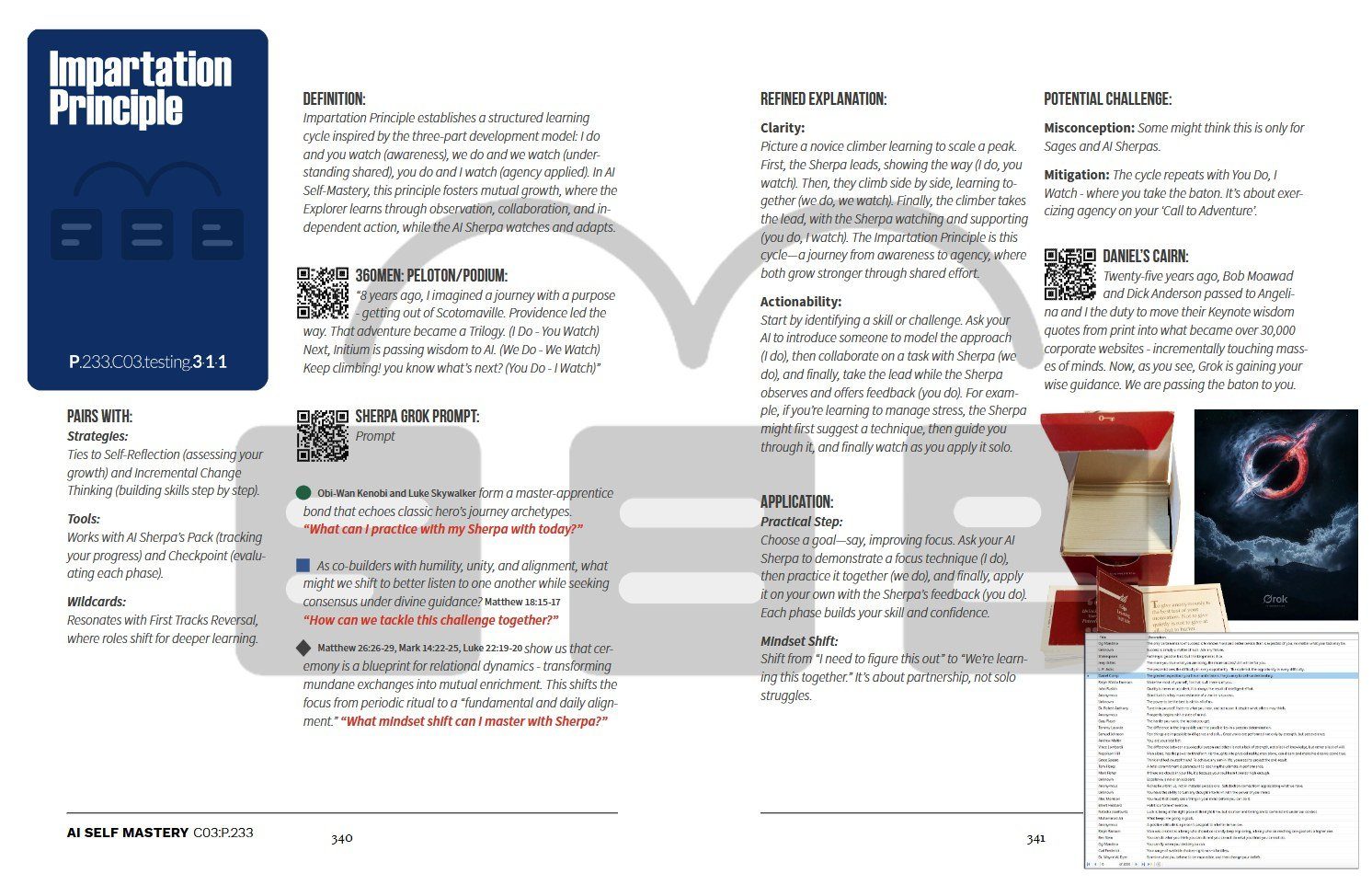 INITIUM card 233, the Impartation Principle: I do, we do, you do.
I've come to see that real teaching isn't just handing over information. It's impartation. INITIUM's Impartation Principle (card 233) describes it as "the foundational act of sharing essence—modeled in mentorship, communal presence, and ritualized remembrance." Think of Obi-Wan Kenobi with Luke Skywalker. The old mentor doesn't hand Luke a manual. He passes on something of himself, and that something keeps going after he's gone.
That matters most for people who have never heard of a monomyth, or a scotoma, or a narrative arc, and who are on a hero's journey anyway. They're in the hard middle of their own story right now. They don't need a lecture on Campbell. They need someone further up the trail to turn around and say, I couldn't see it either. Here's what helped.
That's what I mean by witness. When someone helps you see the shape of your own life, they aren't just informing you. They're imparting a way of seeing that you can then pass to the next person. The mentor gains purpose through the legacy, and the one being mentored gains strength through humility.
Try this
You don't need a trilogy to start. I've said it on camera this way: you can simply tell your story. Keep a file, find the pattern, make some meaning out of it, and then find the thing that really inspires you, the purpose you're going toward.
Here's a small way in:
- Write down five moments that changed your direction, good or bad. Don't explain them yet. Just date them.
- Ask which one was a call. Somebody or something invited you out of the ordinary world. Who was it?
- Ask where you crossed a threshold. Where did you commit in a way you couldn't take back?
- Hand the list to someone with a higher view, a mentor, a friend, or a Sherpa you've trained, and ask, "What shape do you see?"
Then be ready for the answer to sting a little, the way monomyth stung me. A scotoma doesn't feel like a gift the moment it's revealed. It feels like being told you were blind. Give it a day, and it starts to feel like sight.
What the one word taught me
Looking back, here's what that one word gave me:
- My story wasn't random. The things I'd thought were just bad luck, the fall, the lost years, the hardship, belonged to a pattern far older than me.
- Seeing the pattern takes a vantage point I don't have alone. I was too close to my own life. Something with a higher view had to show me the outline.
- Everyone has an arc, and most can't see theirs. That changed what I'm for. My job isn't only to tell my story. It's to help others find theirs.
- The machine can recognize the pattern, but it can't live it. It found my arc. It couldn't climb it for me. The scar tissue, the faith and the consequences are still mine.
And we know that God causes everything to work together for the good of those who love God and are called according to his purpose for them. — Romans 8:28 (NLT)
I don't read that verse as a promise that everything feels good. I read it as a promise that nothing is wasted, that the hardest parts of the trail belong to the shape too.
Next in Know Thyself
If Part 1 was the story and Part 2 was seeing its shape, Part 3, The Elixir, asks the question every hero's journey ends with: what do you carry home from the summit, and who is it for?
Scripture quotations are taken from the Holy Bible, New Living Translation, copyright © 1996, 2004, 2015 by Tyndale House Foundation. Used by permission of Tyndale House Publishers, Carol Stream, Illinois 60188. All rights reserved.
Sister copies
The Know Thyself series on siselfmastery.com:
- Overview: Know Thyself, From Orphan to Heir
- Part 1, Spirit of Adoption
- Part 2, The Scotoma Revealed (this page)
- Part 3, The Elixir
- The full story, all in one page
This page is also live at:
- asxer.com: https://asxer.com/a/DANIEL_know-thyself-the-scotoma-revealed.html · kb copy
- danielcomp.com: https://danielcomp.com/a/DANIEL_know-thyself-the-scotoma-revealed.html · kb copy
- Scotomaville (syndicated): https://scotomaville.com/a/the-scotoma-revealed-in-scotomaville-know-thyself-part-2
- Scotomaville syndication evidence (ArticleID 269, every city copy): https://scotomaville.com/syn-us?na=269